Индоевропейская прародина: С чего все началось...

Re: Индоевропейская прародина: С чего все началось...
Я конечно же понимаю, что в Вики может быть написана всякая ересь, но конкретно в этой статье есть ссылки на все упомянутые первоисточники, которые, в свою очередь, публиковались в достоверных журналах. Таким образом, Армянская гипотеза с каждым годом набирает всё больше доказательств в свою пользу.
𒋩𒂗

Re: Индоевропейская прародина: С чего все началось...
David Reich (geneticist)
Reich has suggested that the Indo-European languages may have originated south of the Caucausus, in present day Iran or Armenia:
"Ancient DNA available from this time in Anatolia shows no evidence of steppe ancestry similar to that in the Yamnaya (although the evidence here is circumstantial as no ancient DNA from the Hittites themselves has yet been published). This suggests to me that the most likely location of the population that first spoke an Indo-European language was south of the Caucasus Mountains, perhaps in present-day Iran or Armenia, because ancient DNA from people who lived there matches what we would expect for a source population both for the Yamnaya and for ancient Anatolians. If this scenario is right the population sent one branch up into the steppe – mixing with steppe hunter-gatherers in a one-to-one ratio to become the Yamnaya as described earlier – and another to Anatolia to found the ancestors of people there who spoke languages such as Hittite."
Reich has suggested that the Indo-European languages may have originated south of the Caucausus, in present day Iran or Armenia:
"Ancient DNA available from this time in Anatolia shows no evidence of steppe ancestry similar to that in the Yamnaya (although the evidence here is circumstantial as no ancient DNA from the Hittites themselves has yet been published). This suggests to me that the most likely location of the population that first spoke an Indo-European language was south of the Caucasus Mountains, perhaps in present-day Iran or Armenia, because ancient DNA from people who lived there matches what we would expect for a source population both for the Yamnaya and for ancient Anatolians. If this scenario is right the population sent one branch up into the steppe – mixing with steppe hunter-gatherers in a one-to-one ratio to become the Yamnaya as described earlier – and another to Anatolia to found the ancestors of people there who spoke languages such as Hittite."
𒋩𒂗
Re: Индоевропейская прародина: С чего все началось...
В 2024 году даже особо в потерянные меры не нужно смотреть, всё в вики уже лежит, а в 2015 приходилось докапываться до недр Землю, чтобы привести хоть одно доказательство в пользу армянской гипотезы.
𒋩𒂗
Re: Индоевропейская прародина: С чего все началось...
Да, спасибо, здесь хороший материал собирается...
Приходите в мой дом...
Re: Индоевропейская прародина: С чего все началось...
Модераторское - про компьютерные программы давайте здесь.
Приходите в мой дом...
Re: Индоевропейская прародина: С чего все началось...
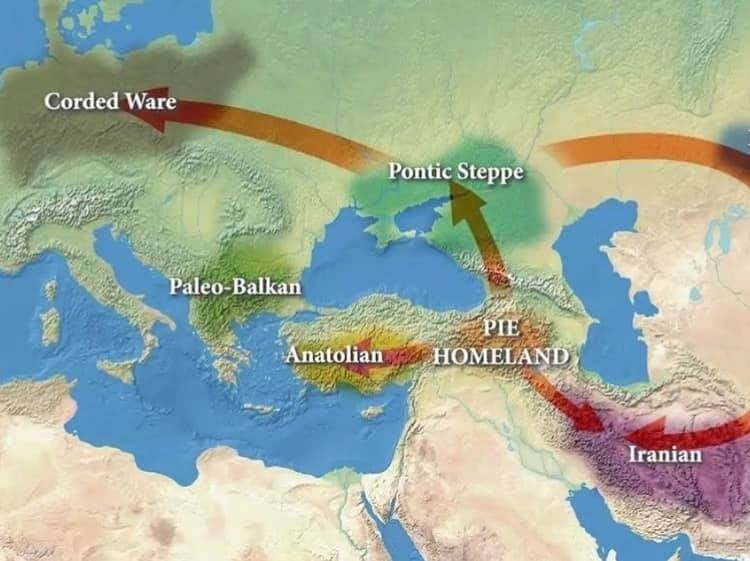
Индоевропейская прародина.
The most likely location of the population that first spoke an Indo-European language was south of the Caucasus Mountains, perhaps in present-day Iran or Armenia, because ancient DNA from people who lived there matches what we would expect for a source population both for the Yamnaya and for ancient Anatolians.
-David Reich 2018 Geneticist at the Harvard Medical School -who received the Dan David Prize in 2017, the NAS Award in Molecular Biology, the Wiley Prize, and the Darwin–Wallace Medal in 2019.
Приходите в мой дом...
Re: Индоевропейская прародина: С чего все началось...
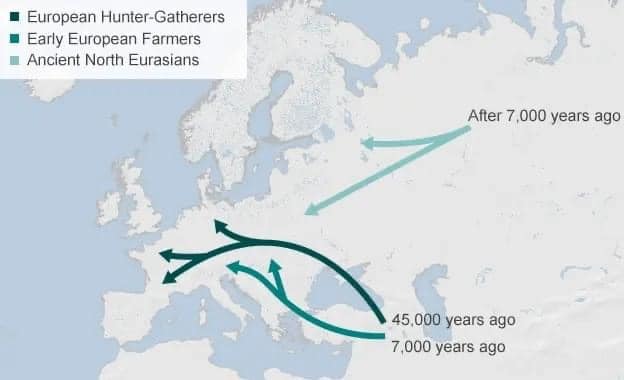
Карта BBC-Science в очередной раз показывает, как и европейцы прибыли в Европу из Армении 45 000 лет назад.
Приходите в мой дом...
Re: Индоевропейская прародина: С чего все началось...
Շնորհակալ եմ, բավականին հին հոդված էր, ինձ թվաց նորություն է։ 
𒋩𒂗
Re: Индоевропейская прародина: С чего все началось...
Այո, ամեն դեպքում լավն էր...
Приходите в мой дом...
Re: Индоевропейская прародина: С чего все началось...
To formally test whether the Sasun received additional gene flow from Assyria compared to other Armenian groups, we conducted a D-statistics in the form D(Sasun, other_modern_Armenian; Assyrian, Mbuti). Our results showed that the Sasun formed a clade with other Armenian populations that is not broken by Assyrians (Table S4). Based on these analyses, we conclude that all modern Armenians are relatively homogeneous while sharing high similarity to the neighboring populations, and there is no evidence for the Sasun harboring an unusually high contribution from Assyrians.
MSMC analyses showed evidence of a population size reduction after 10,000 years ago in the case of Sasun. This finding might underlie their distinct genetic characteristics observed in previous analyses and suggests the bottleneck event and/or the lack of an external gene flow (which would exaggerate population sizes) in Sasun compared to the rest of the Armenian populations. Notably, the population size was even smaller than that of the Sardinians (as depicted in Figure 3C), for whom a substantial population size decrease around the similar time period has been previously demonstrated.35 The other Armenian groups exhibited effective population sizes typical for most mainland Europeans, i.e., with a strong bottleneck between 50,000 and 60,000 years ago, linked to the out-of-Africa expansion, and a subsequent period of rapid population growth.
In our dataset, all Armenians with haplogroup R1b belong to its Yamnaya-associated R-Z2103 lineage.7 Interestingly, its greatest genetic diversity has been observed in the Armenian highlands.24
Taken as a whole, our results support the lack of significant genetic input from the Balkans into ancient and modern populations of the Armenian highlands.
https://www.cell.com/ajhg/fulltext/S0002-9297(24)00391-4#mmc1
MSMC analyses showed evidence of a population size reduction after 10,000 years ago in the case of Sasun. This finding might underlie their distinct genetic characteristics observed in previous analyses and suggests the bottleneck event and/or the lack of an external gene flow (which would exaggerate population sizes) in Sasun compared to the rest of the Armenian populations. Notably, the population size was even smaller than that of the Sardinians (as depicted in Figure 3C), for whom a substantial population size decrease around the similar time period has been previously demonstrated.35 The other Armenian groups exhibited effective population sizes typical for most mainland Europeans, i.e., with a strong bottleneck between 50,000 and 60,000 years ago, linked to the out-of-Africa expansion, and a subsequent period of rapid population growth.
In our dataset, all Armenians with haplogroup R1b belong to its Yamnaya-associated R-Z2103 lineage.7 Interestingly, its greatest genetic diversity has been observed in the Armenian highlands.24
Taken as a whole, our results support the lack of significant genetic input from the Balkans into ancient and modern populations of the Armenian highlands.
https://www.cell.com/ajhg/fulltext/S0002-9297(24)00391-4#mmc1
𒋩𒂗
Re: Индоевропейская прародина: С чего все началось...
Генетический анализ, который научно подтверждает а) армяне не пришли из Балкан или откуда-то; б) сасунцы не имеют ассирийских корней.
𒋩𒂗